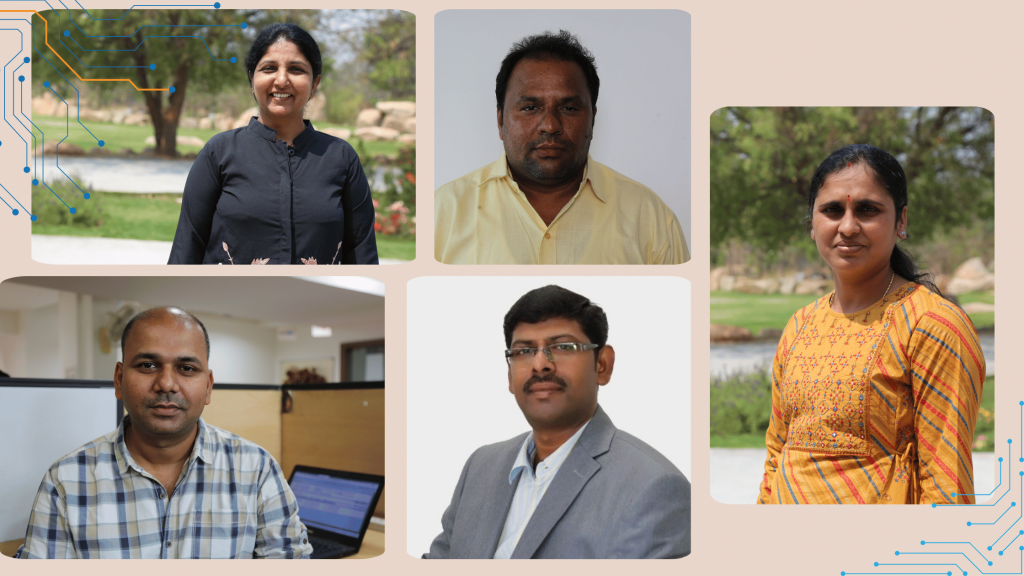
On the five people who actually run Sathguru Soft, and why I stay out of their way.
People assume a company with ten products in the market, four full ERPs, five standalone new age tools, and an application modernisation platform must be a few hundred engineers deep. We are forty-six developers and five managers. Forty-six engineers across all ten products, not forty-six on any single one.
When visitors hear that number, they ask how. And they expect the answer to be about the founder, about ideas, architecture, the person whose name gets attached to the strategy. It isn’t. The honest answer is five people. Five managers who have each spent close to twenty years here, whom I trained early and have not had to manage since. They run delivery, quality, people, and customers. I am not involved in operations at all. Literally zero involvement and that is not a gap in the story, it is the point of it. I want to use this post to do something founders rarely do in public: take my own name out of the sentence and put theirs in.
They keep quality boring
The most underrated achievement in software is the release that doesn’t make news. No outage, no firefight, no apology email to a customer. Just software that works on Monday the way it worked on Friday, across ten products and the couple of hundred companies that run them.
That kind of quiet is expensive to produce and impossible to fake. It comes from people who have seen every failure mode at least twice and built the discipline to prevent the third. Our five have. They have institutional memory measured in decades, and they spend it protecting customers from problems those customers will never know existed. Consistency at this scale, with this few people, is not luck. It is them, choosing the unglamorous thing, every single cycle.
They built the culture I get credit for
When people complement our culture, they are complimenting work I didn’t do. The reason a developer who joins us tends to stay, the reason knowledge passes down instead of walking out the door, the reason forty-six people can carry the load of a far larger team without burning out, that is culture, and culture is built by the people who show up to the hard human conversations. And mind you, we shut down our servers during weekends so that developers need not work. The servers go dark on Friday night at nine and come back on Monday at seven, every single week, unless there is genuine emergency and I have seen such emergency very rarely. And they are the ones who decided it should stay that way.
Our five are the ones who mentor the new joiners, who notice when someone is struggling before it becomes a resignation, who decide a thousand small times a year what kind of place this is going to be. Most of our developers are, in the truest sense, their people, recruited by them, grown by them, trusted by them. A founder can set a tone. Only managers like these can make it last twenty years. And average years an employee stays with us over 12 years. The proof is not just internal. We have been certified a Great Place to Work for ten years without a break and Best Workplace for Women in each of the last two. Those are their badges, not mine. No wonder!
They innovate on delivery every minute
There is a myth that innovation lives only in the product, in features, in algorithms, in the demo. Some of the best innovation I have ever watched lives in how the work gets delivered. How an implementation that used to take months gets compressed. How a support query gets answered before the customer finishes typing it. How a release pipeline quietly gets smarter between one Friday and the next.
Our five don’t innovate on delivery in big-bang reorganisations announced with fanfare. They do it continuously, in increments so small that you only notice the cumulative effect, the fact that we do more, more reliably, with the same forty-six people, year after year. That compounding is invisible day to day and undeniable over a decade.
The best thing a founder can build is his own absence
I spend my time on what is next, new products, new architecture, and one or two ideas I have carried quietly for years that are only now reaching fruition. The one closest to my heart, CodeSelfie, is in a sense an attempt to do for the building of software what these five did for the running of the company: take judgement that took decades to earn and hand it to others as something they can use themselves. I get to chase work like that for exactly one reason, I am not needed in the room where today’s work happens.
The proof is in my calendar. I travel roughly half of every year I am somewhere else entirely, and the company does not miss a beat, no escalation that needs me, no decision that waits for me to land. A business that runs that smoothly in the founder’s absence is not running on the founder.
That used to feel strange to admit. It doesn’t anymore. I have come to believe the highest compliment a founder can be paid is that the place keeps its standards, its culture, and its momentum whether he is there or not. By that measure, these five are the best thing I have ever built, and they built most of themselves.
Our products carry the company’s name. These five carry the company. On a Sunday morning, with nothing on my calendar and the work proceeding perfectly well without me, that feels like exactly the right order of things.
Share